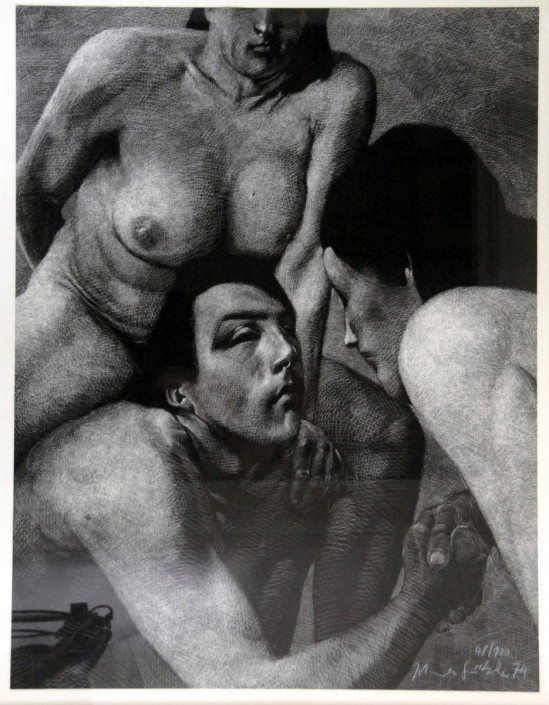
Johannes Grutzke (Berlijn 1937 – Berlijn 2017)
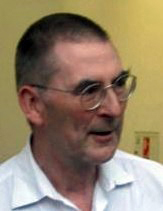
Johannes Grützke was een Duitse figuratieve schilder, tekenaar en graficus, bekend om zijn grotesk‑ironische verbeelding van mensen en hun rollen in de maatschappij. Tijdens z’n lange carrière nam hij een eigenzinnige positie in tegenover de dominante abstracte kunst.
Jeugd en opleiding
Johannes Michael Wilhelm Grützke werd op 30 september 1937 in Berlijn‑Karlshorst geboren als vierde van vijf kinderen in een middenstandsgezin. Tijdens en na de oorlog bracht hij zijn jeugd vooral door in Berlijn‑Moabit, een stedelijke omgeving die mede zijn blik op de gewone mens vormde.
Van 1957 tot 1964 studeerde hij aan de Hochschule für Bildende Künste in Berlijn, eerst bij Hans Orlowski en later als meesterstudent bij Peter Janssen. In 1962 volgde hij een cursus aan de Internationale Sommerakademie für Bildende Kunst in Salzburg, geleid door Oskar Kokoschka, wat zijn affiniteit met expressieve figuratie versterkte.
Eerste stappen als kunstenaar
In 1964 verhuisde Grützke naar Bad Godesberg, waar hij in Galerie Pro zijn eerste solo‑tentoonstelling kreeg. Kort daarna keerde hij terug naar Berlijn en richtte het muziekensemble Die Erlebnisgeiger op, waarmee hij onregelmatig optrad en zijn theatrale gevoel verder ontwikkelde.
Daarnaast werkte hij als illustrator voor een Berlijns satirisch tijdschrift en als toneelknecht om zijn opleiding en werk te financieren, wat hem een scherp oog voor humor, mise‑en‑scène en menselijke typetjes opleverde. Deze ervaringen voedden later zijn “lebende Bilder” en zijn uitgesproken, toneelmatige composities.
School van Nieuwe Pracht
In 1973 was Grützke mede‑oprichter van de kunstenaarsgroep Schule der neuen Prächtigkeit, samen met onder anderen Matthias Koeppel. Deze groep koos bewust voor figuratieve schilderkunst en trad ironisch en barok op tegen de heersende abstracte en conceptuele stromingen in musea en galeries.
Met de groep maakte Grützke onder meer lebende Bilder (levende schilderijen), performatieve en beeldende werken die in heel Duitsland werden getoond. Hij werd al snel gezien als de bekendste en belangrijkste schilder binnen deze kring, en zijn naam raakte nauw met de Schule der neuen Prächtigkeit verbonden.
Docent, toneel en academische loopbaan
Naast zijn vrije werk ontwikkelde Grützke een brede academische en theaterpraktijk. In 1976/77 was hij gastdocent aan de Hochschule für Bildende Künste in Hamburg, en in 1987 doceerde hij aan de Sommerakademie in Salzburg, waar hij ooit zelf leerling was geweest.
Tussen 1985 en 1988 werkte hij als decorontwerper bij het Schauspielhaus in Hamburg, waarmee hij zijn visuele talent op het toneel toepaste. Van 1992 tot 2002 bekleedde hij een professorschap in schilderkunst aan de Akademie der Bildenden Künste in Nürnberg, waarmee hij een nieuwe generatie figuratieve kunstenaars beïnvloedde. Hij was bovendien lid van de Freie Akademie der Künste Hamburg.
Thema’s, stijl en bekende werken
Grützkes werk is uitgesproken figuratief en richt zich consequent op de mens, vaak in tragikomische, sociale en psychologisch geladen situaties. Hij staat bekend om een “onverbiddelijke” realistische blik, waarbij hij lichamen en gezichten soms grotesk en ironisch overdrijft als middel tot herkenning en kritiek.
Humor en intellectuele scherpte vormen de kern van zijn beeldtaal: hij gebruikte klassieke en historische motieven zowel om te verwijzen naar als om te schamperen over traditionele historieschilderkunst. Invloeden van Oskar Kokoschka, maar ook de expressieve figuratie van Egon Schiele, Lucian Freud en Francis Bacon zijn zichtbaar, bijvoorbeeld in tekeningen van extreem magere vrouwen.
Zijn bekendste monumentale werk is de 32 meter lange muurschildering Zug der Volksvertreter (Processie van de volksvertegenwoordigers) in de Paulskirche in Frankfurt am Main, een parade van 160 in het zwart geklede mannen, voltooid begin jaren negentig. Tentoonstellingen in onder meer de Kunsthalle Darmstadt (1979), de Neue Nationalgalerie in Berlijn (1985) en een grote retrospectieve in het Germanisches Nationalmuseum in Nürnberg (2012) bevestigden zijn positie in de Duitse naoorlogse kunst.
Erkenning en nalatenschap
Voor zijn bijdrage aan de figuratieve schilderkunst ontving Grützke onderscheidingen, waaronder het Große Bundesverdienstkreuz en de Hannah‑Höch‑Preis. Zijn werk werd en wordt regelmatig op veilingen aangeboden, waarbij vooral schilderijen aanzienlijke prijzen behalen, wat wijst op een blijvende marktinteresse.
Hij overleed op 17 mei 2017 in Berlijn na een ernstige ziekte, maar zijn oeuvre wordt nog steeds gezien als dat van een van de eigenzinnigste “Menschenmaler” van de Duitse naoorlogse kunst. Recente tentoonstellingen, zoals “Der Menschenmaler” in de Kunsthalle Jesuitenkirche (2025/26), tonen hoe zijn combinatie van subversieve humor, sociale scherpte en figuratieve virtuositeit nieuwe generaties blijft aanspreken.
Johannes Grützke was a German figurative painter, draftsman, and printmaker, known for his grotesque-ironic depictions of people and their roles in society. Throughout his long career, he took an idiosyncratic stance against the dominant abstract art.
Youth and Education
Johannes Michael Wilhelm Grützke was born on September 30, 1937, in Berlin-Karlshorst as the fourth of five children in a middle-class family. During and after the war, he spent his youth primarily in Berlin-Moabit, an urban environment that helped shape his view of the common man.
From 1957 to 1964, he studied at the Hochschule für Bildende Künste in Berlin, first under Hans Orlowski and later as a master student under Peter Janssen. In 1962, he took a course at the International Summer Academy for Visual Arts in Salzburg, led by Oskar Kokoschka, which strengthened his affinity for expressive figuration.
First steps as an artist
In 1964, Grützke moved to Bad Godesberg, where he had his first solo exhibition at Galerie Pro. Shortly thereafter, he returned to Berlin and founded the music ensemble Die Erlebnisgeiger, with which he performed irregularly and further developed his theatrical sensibility.
In addition, he worked as an illustrator for a Berlin satirical magazine and as a stagehand to finance his education and work, which gave him a keen eye for humor, mise-en-scène, and human characters. These experiences later nourished his “living images” and his distinctive, theatrical compositions. School of the New Splendor
School of New Splendor
In 1973, Grützke was a co-founder of the artist group School of the New Splendor, together with Matthias Koeppel, among others. This group consciously chose figurative painting and acted ironically and baroquely against the prevailing abstract and conceptual movements in museums and galleries.
With the group, Grützke created, among other things, *lebende Bilder* (living paintings), performative and visual works that were shown throughout Germany. He was soon regarded as the most famous and important painter within this circle, and his name became closely associated with the School of the New Splendor.
Teacher, theater, and academic career
In addition to his independent work, Grützke developed a broad academic and theater practice. In 1976/77, he was a visiting lecturer at the Hochschule für Bildende Künste in Hamburg, and in 1987 he taught at the Sommerakademie in Salzburg, where he had once been a student himself.
Between 1985 and 1988, he worked as a set designer at the Schauspielhaus in Hamburg, applying his visual talent to the stage. From 1992 to 2002, he held a professorship in painting at the Akademie der Bildenden Künste in Nuremberg, influencing a new generation of figurative artists. He was also a member of the Freie Akademie der Künste Hamburg.
Themes, style, and famous works
Grützke’s work is distinctly figurative and consistently focuses on the human being, often in tragicomic, social, and psychologically charged situations. He is known for an “uncompromising” realistic gaze, in which he sometimes grotesquely and ironically exaggerates bodies and faces as a means of recognition and criticism.
Humor and intellectual sharpness form the core of his visual language: he used classical and historical motifs both to allude to and to scoff at traditional historical painting. Influences from Oskar Kokoschka, as well as the expressive figuration of Egon Schiele, Lucian Freud, and Francis Bacon, are visible, for example in drawings of extremely thin women.
His most famous monumental work is the 32-meter-long mural *Zug der Volksvertreter* (Procession of the Representatives) in the St. Paul’s Church in Frankfurt am Main, a parade of 160 men dressed in black, completed in the early 1990s. Exhibitions at venues including the Kunsthalle Darmstadt (1979), the Neue Nationalgalerie in Berlin (1985), and a major retrospective at the Germanisches Nationalmuseum in Nuremberg (2012) confirmed his position in German post-war art.
Recognition and Legacy
For his contribution to figurative painting, Grützke received awards, including the Große Bundesverdienstkreuz and the Hannah‑Höch‑Preis. His work was and is regularly offered at auctions, where paintings in particular fetch substantial prices, indicating enduring market interest.
He passed away on May 17, 2017, in Berlin following a serious illness, but his oeuvre is still regarded as that of one of the most idiosyncratic “Menschenmaler” of German post-war art. Recent exhibitions, such as “Der Menschenmaler” at the Kunsthalle Jesuitenkirche (2025/26), show how his combination of subversive humor, social acumen, and figurative virtuosity continues to appeal to new generations.
Foto uitsnede van het werk:
Von Justus Nussbaum – Eigenes Werk, CC BY-SA 3.0, https://commons.wikimedia.org/w/index.php?curid=19424810